Don't Crash: The No-Bullshit Guide to How Drones Actually Fly

A 10-minute deep dive into the math keeping your quadcopter out of the dirt. Or in other words, Control Theory explained without the academic ego.
If you've ever watched a racing drone snap into a turn at 100mph or a camera drone hover perfectly still while a gust of wind tries to toss it like a ragdoll, you’re witnessing a mathematical miracle. To you, it looks like magic. To the drone, it’s a high-speed panic attack where it’s solving calculus thousands of times a second just to stay upright.
Most people think drones are "programmed" to fly. They aren't. Drones are calculated into the air. If the math stops for even a fraction of a second, gravity wins. Let’s look at the "Math Bosses" that make this happen, moving from the sensors to the motors.
Boss 1: The Fourier Transform (The "Noise Detective")
Imagine you're at a crowded party. There’s a thumping bass, a screaming singer, and some asshole in the corner dropping a glass. To a simple microphone, that’s just one messy "noise" signal. But your brain is incredible—it can "deconstruct" that noise. You can ignore the glass breaking and focus entirely on the lead singer.
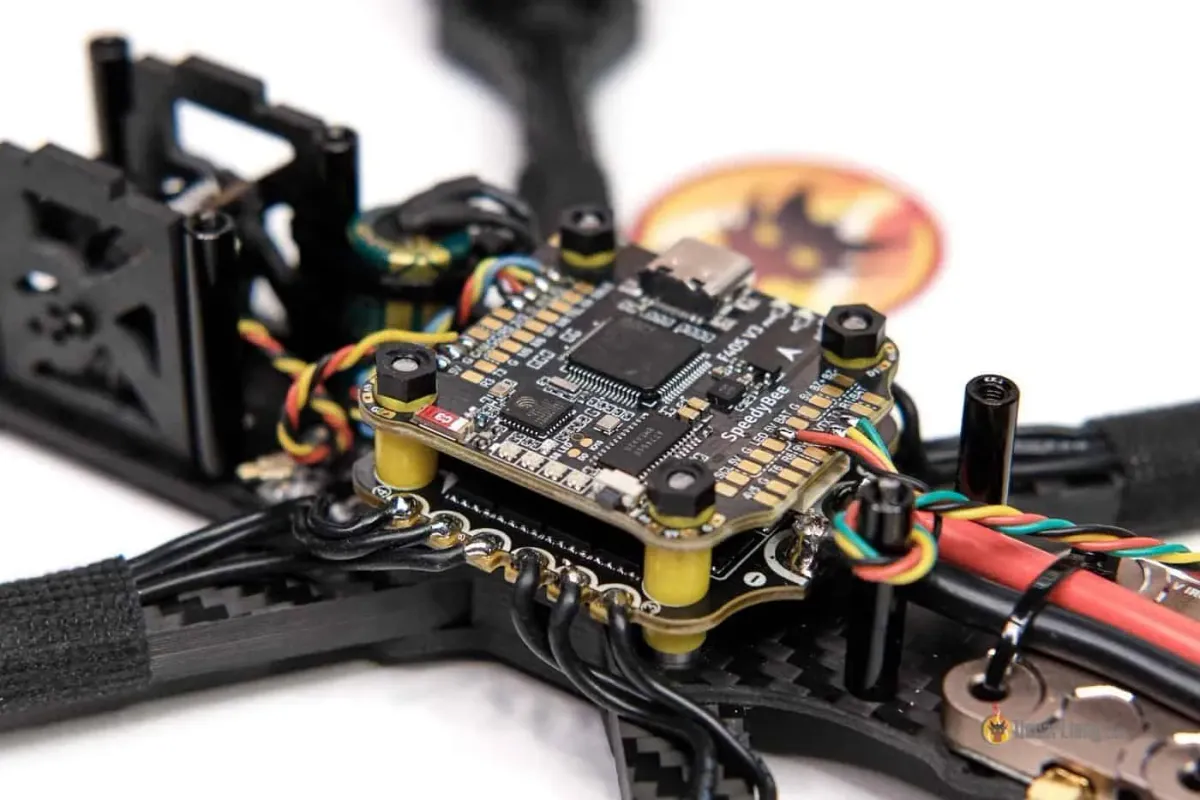
A drone has to do the same thing. Its "ears" are Gyroscopes, which measure how fast the drone is rotating. But gyros are incredibly sensitive. Every time a motor spins, it creates a tiny vibration. If your props are slightly chipped, they create a massive "scream" of vibration.
To the drone, the raw data looks like a jagged, chaotic mess (the Time Domain). The Fourier Transform \(\mathcal{F}\) is the math that allows the drone to see through that mess. It takes the jagged line and turns it into a "frequency map":
\[ F(\omega) = \int_{-\infty}^{\infty} f(t) e^{-i \omega t} dt \]
The "Aha!" Moment: By looking at this map, the drone can see a huge spike at exactly 180Hz. It knows that 180Hz isn't you moving the sticks—it's just a vibrating motor. It labels that frequency as "bullshit" so the rest of the system can ignore it.
Boss 2: Filters (The "Signal Bodyguards")
Once the Fourier Transform identifies the noise, the drone needs a way to kill it. It uses two main bodyguards to protect the clean signal.
The Low-Pass Filter (The Sledgehammer)
In the drone world, "High Frequency" (fast shaking) almost always equals noise, and "Low Frequency" (slow movements) equals actual flight. A Low-Pass Filter (LPF) is like a heavy velvet curtain. It allows the deep, slow "rumbles" of your stick movements to pass through, but it completely muffles the high-pitched "hiss" of motor vibrations. It smooths out the jagged edges of the data so the drone doesn't twitch every time a motor spins.
The Notch Filter (The Scalpel)
Sometimes the noise is so loud that a curtain isn't enough; you need a surgeon. A Notch Filter is designed to kill one specific frequency. If the Fourier Transform says, "Hey, we have a massive vibration at exactly 215Hz," the Notch Filter cuts a surgical hole in the data at 215Hz. It lets everything else through but silences that one specific "scream."
Boss 3: The Kalman Filter (The "Fortune Teller")
This is where the math gets spooky. Sensors lie. A Gyroscope might tell you you're rotating, but over time it "drifts." An Accelerometer tells you where gravity is, but it gets confused if the drone is vibrating. They are like two witnesses to a crime who both have blurry vision and different stories.
The Kalman Filter is an algorithm that acts as a genius judge. It doesn't just "average" the sensors; it predicts the future.
- Step 1 (The Prediction): Based on what happened a millisecond ago, the Kalman filter calculates where the drone should be right now using the laws of physics.
- Step 2 (The Reality Check): It then looks at the messy sensor data. If the sensor says the drone just teleported 5 feet, the Kalman filter says, "I know physics, and that's impossible. I trust my prediction more than your shitty sensor."
It constantly balances its "internal logic" with "external observation" to find the Optimal Truth. This is why modern drones feel so eerily stable—they are flying on a mathematical "prediction" of reality that is cleaner than reality itself.
Boss 4: The PID Loop (The "Muscle")
Now that the drone has a clean, truthful "state," it needs to move the motors. This is the PID Loop. It’s a constant conversation between where the drone is and where you want it to be (the Error, \(e(t)\)).
\[ u(t) = K_{p} e(t) + K_{i} \int_{0}^{t} e(\tau) d\tau + K_{d} \frac{de(t)}{dt} \]
Think of it like three different pilots trying to steer the same ship:
- The P-Pilot (Proportional): "Fix it NOW!" This pilot is pure muscle. If the drone is tilted, he pushes the motors. The bigger the tilt, the harder he pushes. If he’s too aggressive, the drone overshoots and starts a violent "wobble."
- The I-Pilot (Integral): "Don't forget the wind!" This pilot has a memory. If a crosswind has been pushing the drone left for 5 seconds, the I-pilot notices that the "P" pilot isn't quite winning. He slowly adds more and more pressure until the drone is perfectly level. He fixes Steady-State Error.
- The D-Pilot (Derivative): "Easy does it!" This pilot looks at the speed of the correction. If the drone is snapping back to level too fast, the D-pilot applies the "brakes" to make sure the drone stops exactly where it should without a single bounce.
The Final Boss: Phase Latency (The "Lag" of Death)
Why can't we just add a million filters and make the drone perfectly smooth? Because every single math equation takes Time. In engineering, we call this Phase Latency.
If your Fourier Transform, Kalman Filter, and PID Loop take 15 milliseconds to calculate, your drone is effectively reacting to the past. It’s like trying to drive a car while looking through a camera with a 2-second delay. You will turn the wheel, see nothing happen, turn it more, and then—SPLAT—you've overcorrected into a tree.
This is why high-end drones run at 8,000Hz (8kHz). They solve these massive calculus problems 8,000 times every single second. They have to be that fast so that the "math" happens faster than the physics of the crash.
Conclusion: The Marriage of Math and Flight
The next time you see a drone hovering in the sky, remember that it isn't "still." It is a vibrating, chaotic machine held in a state of grace by a series of mathematical "Bosses." The filters give it Clarity, the Kalman filter gives it Truth, and the PID loop gives it Will.
Without this duo, drones would be nothing more than expensive, falling bricks. But with them, they become an extension of our own hands in the sky. Fly safe, and respect the math.