The Lipid Substitution Crisis: A Biochemical Longitudinal Analysis of Industrial Seed Oils in the Human Diet

Since the early 20th century, the human nutritional landscape has undergone a radical shift: the systematic replacement of evolutionarily consistent animal fats with industrially processed seed oils. This article explores the biochemical implications of this transition, focusing on the oxidative instability of Polyunsaturated Fatty Acids (PUFAs), the geometric distortion of trans-fats, and the clinical evidence suggesting that this substitution is a primary driver of mitochondrial dysfunction and systemic metabolic failure.
1. The Industrial Genesis: From Industrial Lubricant to Food
The introduction of seed oils into the human diet was driven by industrial surplus rather than nutritional science. Before 1860, "seed oils" were non-existent in the human food supply. Cottonseed, a byproduct of the textile industry, was classified as toxic waste due to high concentrations of gossypol—a natural phenol that acts as a metabolic poison.
The pivot occurred in 1911 with the introduction of hydrogenated cottonseed oil. By utilizing high-heat refinement (230°C) and nickel-catalyzed hydrogenation, manufacturers transformed a volatile industrial waste product into a shelf-stable solid fat. This represented the first time in human history that a chemically altered, high-Linoleic acid substance became a primary source of dietary lipid.
2. The Margarine Scam: Synthetic Geometry
The most egregious chapter of the seed oil era began with the rise of Margarine. To compete with butter, the industry needed liquid seed oils to remain solid at room temperature. This was achieved through Partial Hydrogenation.
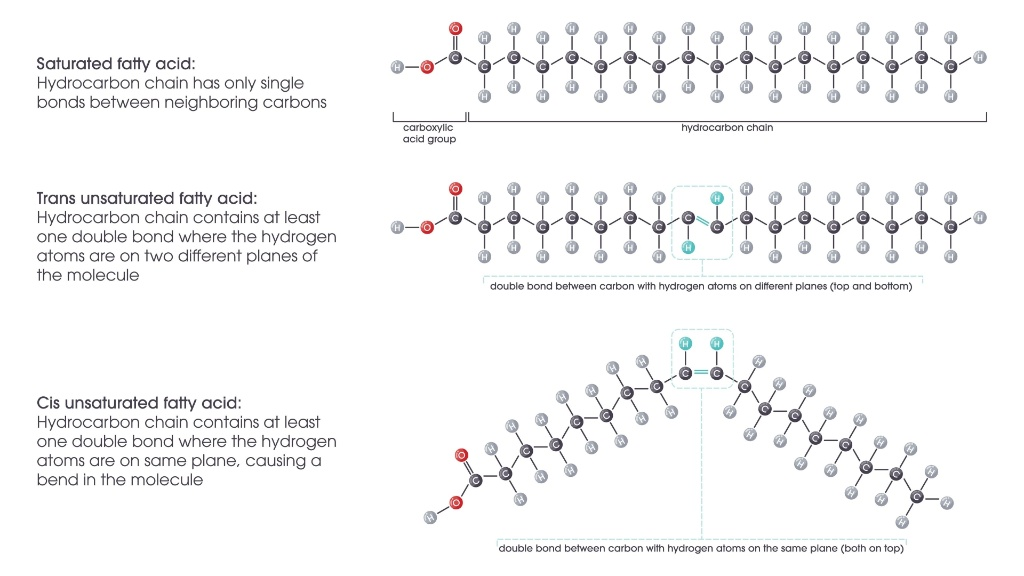
In nature, unsaturated fats exist in a Cis configuration, where the hydrogen atoms are on the same side of the double bond, creating a natural kink in the molecule that keeps it liquid. Partial hydrogenation forces these atoms to opposite sides, creating a Trans configuration. This straightens the molecule, allowing it to pack tightly and mimic the texture of butter.
The Physiological Failure: The human body lacks the enzymes to process these synthetic trans-fats. Because they mimic the shape of saturated fats but possess the reactivity of unsaturated fats, they are mistakenly incorporated into cell membranes and arterial walls, leading to:
- Systemic Rigidity: Cell membranes lose their fluidity, impairing nutrient transport.
- Pro-Atherogenic Signaling: Trans-fats are now universally recognized to lower HDL (what your doctor would call "good" cholesterol) while raising LDL (the nasty one), a primary driver of the mid-to-late 20th-century heart disease spike.
3. Molecular Instability: The Chemistry of Peroxidation
The primary danger of seed oils lies in their chemical structure.
- Natural Saturated Fats: Possess a straight carbon chain fully saturated with hydrogen atoms. This lack of double bonds makes them highly resistant to heat and oxygen.
- Man made Polyunsaturated Fats (PUFAs): Contain multiple double bonds. In chemistry, these double bonds are sites of extreme vulnerability. When exposed to heat, light, or body temperature, these bonds break, leading to Lipid Peroxidation.
When Linoleic Acid (the primary Omega-6 in seed oils) oxidizes, it produces toxic aldehydes, most notably 4-Hydroxynonenal (4-HNE). 4-HNE is a highly reactive electrophile that binds to cellular proteins and DNA, causing "protein adducts" that impair enzyme function and trigger a cascade of systemic inflammation. To put the volatility in perspective: when standard rapesees (canola) oil is heated to normal frying temperatures (180°C), it rapidly degrades, producing measurable levels of these toxic polar compounds within just 30 minutes.
4. The Adipose Reservoir: Physiological Alteration over Time
The most alarming data point regarding PUFAs is their biological persistence. Linoleic acid is not cleanly burned as fuel; it is structurally incorporated into human adipose (fat) tissue.
A landmark 2015 study analyzing human fat biopsies from 1959 to 2008 revealed a catastrophic structural shift in human biology. In 1959, the concentration of Linoleic Acid in human fat tissue was 9.1%. By 2008, it had skyrocketed to 21.5% (Guyenet, S. J., & Carlson, S. E. Advances in Nutrition).
Furthermore, the biological half-life of Linoleic Acid in human adipose tissue is approximately 680 days. This means that even after adopting a clean, seed-oil-free diet, it takes the human body nearly two years to purge just half of the accumulated toxic payload.
5. Mitochondrial Failure: The Cardiolipin Mechanism
The most critical impact of a high-PUFA diet occurs within the mitochondria. The inner mitochondrial membrane contains a unique phospholipid called Cardiolipin, which is essential for the function of the electron transport chain.
Evolutionarily, cardiolipin is composed of stable fats. However, high intake of seed oils forces the body to incorporate Linoleic Acid into the cardiolipin structure. Because Linoleic Acid is prone to oxidation, the cardiolipin becomes "leaky." This leads to:
- Reduced ATP Production: The cellular energy production engine becomes inefficient.
- Superoxide Leakage: The mitochondria begin spraying free radicals into the cell.
- Apoptosis: The cell eventually triggers a self-destruct sequence.
6. Clinical Evidence: The Recovered Data
The most damning evidence against the seed-oil-substitution theory comes from clinical trials that were suppressed or ignored for decades because the data contradicted the prevailing nutritional dogma.
The Minnesota Coronary Experiment (1968–1973): A randomized controlled trial involving 9,423 participants. The intervention group replaced saturated fat with corn oil.
- The Findings: While their cholesterol dropped, the risk of death actually increased. For every 30 mg/dL drop in cholesterol, there was a 22% higher risk of death.
- Citation: Ramsden, C. E., et al. (2016). "Re-evaluation of the traditional diet-heart hypothesis." BMJ, 353, i1246.
The Sydney Diet Heart Study (1966–1973): A secondary prevention trial where the intervention group replaced butter and saturated fats with safflower oil (high in Omega-6 Linoleic Acid).
- The Findings: The seed oil group experienced a significantly higher all-cause mortality rate (17.6%) compared to the control group (11.8%). They also saw increased rates of death specifically from cardiovascular disease.
- Citation: Ramsden, C. E., et al. (2013). "Use of dietary linoleic acid for secondary prevention of coronary heart disease and death." BMJ, 346, e8707.
7. The "Hateful Eight" and the Extraction Process
To understand why these oils are toxic, one must observe the extraction process. Unlike olive oil (pressed from fruit through mechanical means) or butter (churned from cream), seed oils require a massive industrial footprint:
- Hexane Extraction: Seeds are soaked in petroleum-based solvents to maximize yield.
- Degumming: Using phosphoric acid to remove phospholipids.
- Bleaching: Filtering through clay to remove the dark, rancid color.
- Deodorizing: Subjecting the oil to high-pressure steam (often exceeding 250°C) to remove the "fishy" smell caused by pre-bottling oxidation.
The Hateful Eight to Avoid: Soybean, Corn, Cottonseed, Sunflower, Safflower, Grapeseed, Rice Bran, and Rapeseed (sold as Canola in the US).
8. Conclusion: The Economics of a Metabolic Pandemic
If the clinical evidence is so disastrous, why does the global food supply continue to rely on this flawed paradigm? The answer lies not in biology, but in corporate economics.
The modern food-industrial complex operates on a model of maximized profit margins and extended shelf life. Seed oils are the cheapest, most heavily subsidized calories on the planet. By replacing biologically expensive animal fats with industrial derivatives, food industries have engineered a food supply that is highly profitable but metabolically devastating. This prioritization of yield over yield-quality has triggered one of the worst pandemics in human history. The exploding global rates of obesity, type 2 diabetes, and cardiovascular failure are not a sudden failure of human genetics; they are the predictable downstream effects of an industrialized, seed-oil-laden food supply.
As we evaluate our physiological framework, the evidence suggests that the lipid substrate we provide our cells is the single most important variable in metabolic health. By returning to evolutionarily consistent, stable fats (Tallow, Butter, Ghee, Olive Oil, and Avocado Oil), we are essentially:
- Lowering the systemic oxidative burden.
- Restoring mitochondrial integrity via stable cardiolipin.
- Eliminating synthetic trans-fats from the cellular architecture.
True health optimization requires a return to the chemistry our bodies were evolutionarily designed to utilize, and a complete divestment from an industry that profits from our chronic sickness.