The TV, The Trap, and The 2026 Reset: Why Waking Up is a Bitch (But Necessary)

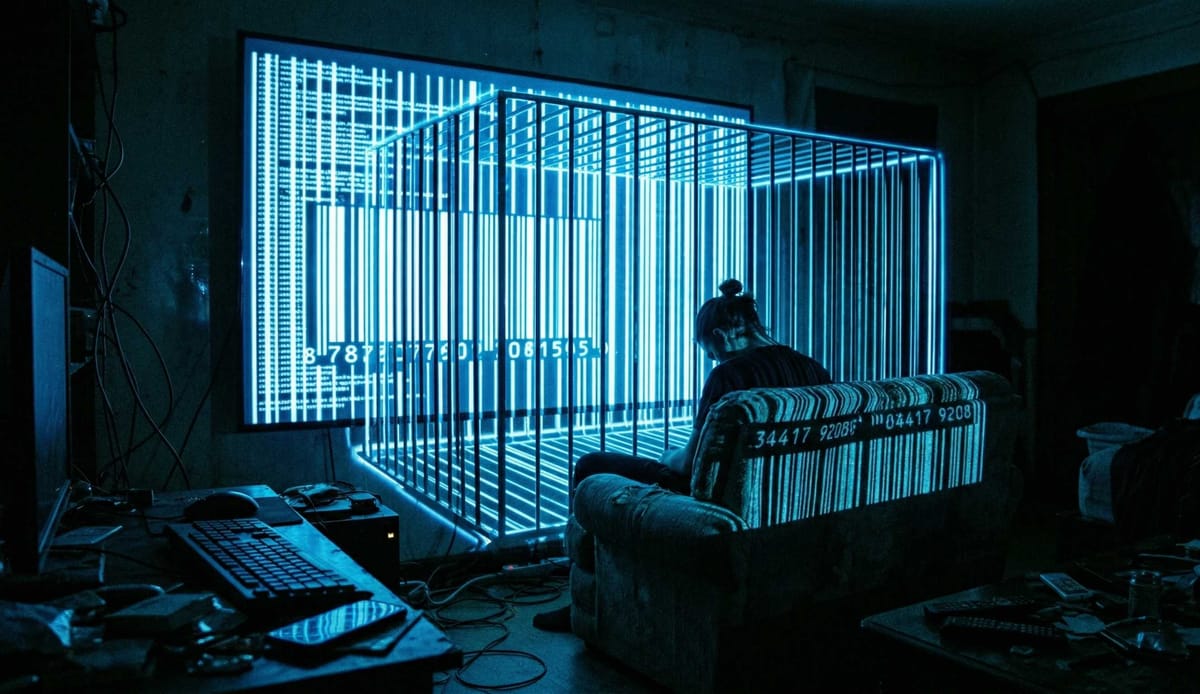
It was a Tuesday afternoon, and my fucking telly was refusing to cooperate. It wasn't broken; it was just doing what modern "smart" tech does best—trapping me in a bloated, ad-ridden corporate UI that fought my every attempt to just watch what I actually wanted. The system existed only to serve me targeted ads, track my habits, and keep me inside its walled garden. Looking at it, I realized it wasn't just a piece of electronics anymore; it was a black mirror reflecting exactly what our society has become—completely mercified, a transaction engine designed to squeeze profit out of every second of your existence.
Instead of giving in and letting the algorithm win, I spent the next hour swearing at an old Raspberry Pi 4, flashing LibreELEC onto an SD card, and bypassing their entire bloody ecosystem. I essentially lobotomized their proprietary spyware and turned it back into a dumb monitor running open-source code.
It felt like a tiny, exhausting victory. But as I sat there, drinking a glass of £7 per bottle Bordeaux Superieur bought at Lidl and watching the Pi finally boot up, it made me think about a man I used to know.
My former father-in-law spent his entire existence in a perfectly curated loop: wake up at 6 AM, sit in front of the telly, go to bed at 8 PM. Rinse and repeat for decades. His life was absolute bliss because his world was entirely 2D. He never looked behind the screen, never questioned the narrative, and never felt the crushing weight of the world outside his living room.
For that boomer, the telly was the ultimate pacifier. For the youngest generation today, it’s the endless, brain-melting TikTok scroll. Different screens, same fucking coma. It’s all just a low-pass filter to keep you numb so you don't ask why the ship is taking on water.
In 2026, I catch myself envying that man. Ignorance isn't just 'bliss'; right now, it’s a high-end survival strategy.
Because if you’re actually awake right now—if you have even a shred of observation running in the background of your brain—you are forced to watch a global shitshow unfold in real-time. But here’s the cold truth: the people sitting in front of their TV sets or endlessly scrolling TikTok, happily ignoring the fire, are just passengers on a sinking ship. They’ll drown in their sleep.
If we want to survive what’s coming, we have to endure the burden of staying awake.
The Dopamine-Debt Pipeline
The world currently runs on a very simple, highly engineered loop: make them lonely, make them scroll, make them buy.
We are living through an epidemic of isolation. The system has priced us out of community and replaced it with commodities. When you feel disconnected, your brain literally aches for validation. The algorithms know this. So, they slide a shiny new toy into your feed—a £3,000 Gucci handbag, the latest £80,000 SUV on a bloody 29% APR PCP deal, or some fast-fashion garbage you don't need.
Clicking "Buy Now" gives you a five-minute dopamine surge. For a brief second, you feel like a winner. You feel like you have a personality. And then the cardboard box arrives, the feeling evaporates, and you’re left with the bill.
This isn't an accident. While the working and middle class are absolutely skint, corporations are registering record profits. How? Because people are financing their emotional regulation with debt they will never be able to pay back. We’ve traded our financial futures for temporary bandages on our psychological wounds. We are financing the yachts of the 0.001% using our own despair as collateral.
The Schindler Math of the Modern World
When you wake up to this reality, it ruins the illusion of the shopping mall forever. You stop seeing "stuff" and start seeing the underlying math.
Think about that scene in Schindler’s List where he breaks down crying over his gold lapel pin, realizing it could have bought another human life. That’s the exact math of 2026.
We live in a world where billionaire wealth has surged to over $18 trillion, yet one in four people globally faces regular food insecurity. That £3,000 handbag isn't just leather and a logo; in the grand ledger of human suffering, it’s the cost of keeping a family alive in a conflict zone for six months. It’s the cost of malaria nets that actually save children.
When you see the world this way, it’s overwhelming. You realize that the "marginal gains" of the elite are built squarely on the backs of the exploited. You see the systemic racism, the environmental destruction, and the endless wars for oil and profit. It makes you want to crawl back into the blissful coma of the telly. It hurts to be the one who cares in a system that prices empathy at zero.
Refusing to Cooperate: How to Become a Glitch in the Matrix
So, what do we do? We can't single-handedly overthrow the billionaires currently building their luxury survival bunkers in New Zealand.
But here is the hilarious, fatal flaw in their apocalypse prep: they forget that if the shit actually hits the fan, their billions become useless digital ghosts in a matter of seconds. When the banking servers go dark, who do you think is going to run the show inside that bunker? It won’t be the tech-bro CEO. It will be the man with the gun who was hired for "security." You can't buy loyalty with a dead currency. The heads won't just fall in the streets as it happened in the révolution française in 1789; they’ll fall behind those 10-ton blast doors when the guards realize their hungry kids are worth more than a billionaire's spreadsheet.
Their empire isn't just built on stone and steel; it’s built on the interest from your credit cards and the predictability of your compliance. We don’t have to wait for the total collapse to prove their spreadsheets are worthless—we can start making ourselves useless to them right now.
The system relies on your predictability. It needs you to be in debt. It needs you to be a consumer.
Opt out. Keep the credit card balance at £0. Starve the banks of your interest payments. Stop buying the "lifestyle" they are selling. That Lidl Bordeaux tastes a hell of a lot better when you know you didn't finance it at 39% APR.
Instead of investing in depreciating status symbols, invest in your own mental hardware. Learn to code. Build FPV drones or anyhing else you like. Flash open-source operating systems onto single-board computers. Subscribe to tools that make you sharper, not platforms that make you numb. When the debt bubble finally pops—and the global supply chain chokeholds tell us it's coming—the only currency that will matter is what you know how to build, fix, and solve.
The elite want a population of dependent consumers. A self-reliant, debt-free individual with a sharp brain and zero fucks to give is their worst nightmare.
The Strauss-Howe Theory and the Controlled Descent
If you feel a deep, gut-wrenching dread that "something is coming," you aren't crazy. You’re just feeling the physics of the situation.
In 1997, historians William Strauss and Neil Howe formalized what is now known as the Strauss-Howe Generational Theory. Analyzing over 400 years of history, they proved that human progress doesn't move in a straight line—it moves in roughly 80-year cycles called "saecula." Each cycle is broken into four distinct chapters: a post-crisis High, a rebellious Awakening, a cynical Unraveling (driven by the hyper-individualism and greed of the 80s and 90s), and finally, a Crisis.
They called this crisis the Fourth Turning. It’s the violent, chaotic end of the cycle where old, brittle institutions completely collapse to make way for a new social contract. Decades ago, they predicted this societal reset would climax exactly right now, in the mid-2020s. We are living squarely in the blast radius of that prediction.
Physicists, however, don't bother with generational theories; they just call it entropy. The Second Law of Thermodynamics is the one rule you can't bribe your way out of:
$$dS \geq 0$$
In a natural system, energy wants to spread out until it reaches equilibrium. When 60,000 people hoard three times the wealth of half the planet, they are effectively fighting the Second Law. They’ve spent decades forcing all the "order" and resources into a tiny, hyper-dense bubble at the top, leaving the rest of the system to rot in a state of high-entropy neglect.
A system with such extreme, artificial "order" at the top is incredibly brittle and high-pressure. It’s a physical anomaly. In thermodynamics, the "Reset" isn't just a political choice; it’s the moment the bubble pops and the energy is forced back into equilibrium. The universe doesn't give a shit about your net worth or your bunker blueprints; it only cares about balancing the scales. That level of extreme imbalance is physically unsustainable. It's a pressurized anomaly, and the math will eventually, and often violently, correct itself to restore the natural flow.
But there is a sliver of hope in the data. The reset doesn't have to be a total Mad Max wasteland. There are signs of a "Controlled Descent" if we look closely at the macro-shifts of 2026:
- The Energy Pivot: For the first time in history, global capital is pouring $2.2 trillion into clean energy—double what is going into fossil fuels. The engine of the world is slowly being swapped out while we’re still driving.
- The High Seas Treaty: We are finally putting legal borders on the Wild West of corporate ocean plundering, placing two-thirds of the world's oceans under international protection.
- The Circular Economy: The market for repair and remanufacturing is hitting $578 billion for the first time in history. The unsustainable buy and bin model is starting to crack under its own weight.
We Are the Founders of the Future
In the 24th-century world of Star Trek, Captain Jean-Luc Picard famously described their post-scarcity utopia: “The acquisition of wealth is no longer the driving force in our lives. We work to better ourselves and the rest of humanity.”
It sounds like a dream, doesn't it? But we have to be honest with ourselves: we might not live to see that world where money means nothing and humanity works purely for the common good. We might just be the generation that has to shovel the shit to fertilize that future garden.
But every time you solder a broken wire instead of clicking “Buy Now,” every time you share your code for free, and every time you stare at the brutal math of this world and refuse to look away—you are laying the bricks for that world.
Yes, it is lonely. Yes, it is fucking terrifying. But to the peer you pull out of the digital void, you aren't just an insignificant cog; you are the entire universe balancing itself. You are the living, breathing proof that humanity hasn't entirely sold its soul to the algorithm.
They built a massive machine that runs exclusively on your apathy and your debt. Starve it. Keep the TV unplugged. Throw the TikTok scroll into the sun. Let the neurons fire in cascade, even when the reality of it stings. We might all end up as water vapour and carbon eventually, but until the physics catch up with us, we can make this system choke on our independence.
Be the friction. Be the glitch. It’s time to wake the fuck up.